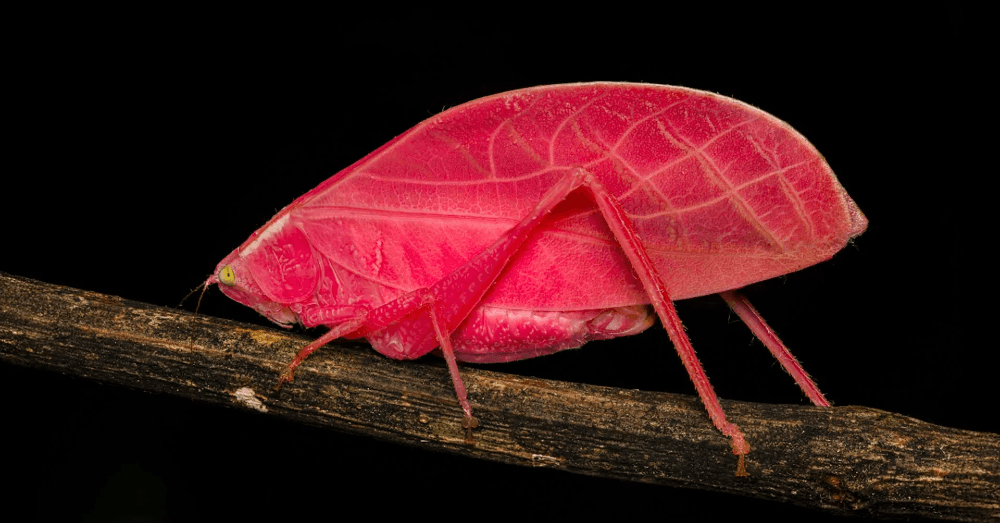
A tiny insect in the Panamanian rainforest just shook up more than a century of textbook thinking. A leaf-mimicking katydid, glowing an almost cartoonish hot pink, gradually faded into ordinary green over the span of about 11 days, leaving researchers convinced it’s not a freak of nature at all but a finely tuned mimic of young tropical leaves.
- Researchers documented an adult female Arota festae shifting from hot pink to pastel pink to full green in 11 days.
- The color shift appears to mimic “delayed greening,” a process where new leaves emerge pink before turning green.
- Pink katydids, noted in scientific records since 1878, were long dismissed as disadvantageous mutations.
A Midnight Sighting on Barro Colorado Island
The discovery happened on Barro Colorado Island, a well-known tropical research site in Panama, at 11:12 p.m. on March 27, 2025. An adult female Arota festae displaying intense hot pink coloration was found underneath a research station light, within about 16 feet of primary tropical rainforest. The team, led by biologist Benito Wainwright of the University of St Andrews, decided to bring her back to the lab and watch what happened next.
What followed was the real surprise. Over 30 days, the research team observed the hot pink insect at natural ambient temperatures and humidity. By day four, the bug’s bright pink body had faded to a pastel pink. By day 11, it was indistinguishable from the standard green version. The insect lived long enough to mate before dying naturally the following month.
Why Pink Actually Works as Camouflage
It sounds backwards, but a hot pink bug in a green forest may not be as obvious as you’d think. In many tropical plants, new leaves don’t start out green. Instead, they emerge in a flush of bright pink or red, a phenomenon known as delayed greening. These young leaves are rich in anthocyanins, pigments that shield delicate tissues from UV damage and may deter herbivores.
Roughly 36% of plant species on Barro Colorado Island exhibit delayed greening, creating a steady supply of pink foliage throughout the year. That means at any given moment, there’s a real chance a pink katydid could be sitting near a flush of pink shoots and look like nothing more than another tender, chemically protected leaf. Previous research using DNA analysis of digestive tract contents has shown that Arota festae on Barro Colorado Island feeds on tree species that undergo delayed greening, meaning these insects already live in close proximity to the pink leaves they may be imitating.
Rewriting a 19th-Century Assumption
Pink katydids have been documented in scientific literature since 1878 but were generally considered a rare, disadvantageous mutation. This appears to be the first recorded case of a katydid completing a full color shift within a single life stage. For more than 140 years, those startling pink specimens were filed away as flukes, unlucky bugs that wouldn’t last long because predators would spot them in seconds.
The new study, published in the journal Ecology, flips that thinking. From the rainforests of Panama to nature lovers in Fairborn, OH following the news, the takeaway is the same. A color once labeled a defect may actually be a clever, time-released disguise. This discovery reframes camouflage as a dynamic process rather than a fixed trait. The pink Arota festae isn’t hiding passively. It is actively tracking the life cycle of the forest. By shifting from pink to green in sync with the foliage, it maintains a continuous disguise, a sophisticated strategy known as dynamic matching.
What Researchers Still Want to Know
One katydid, no matter how photogenic, isn’t enough to close the case. As ecologist Cole pointed out in coverage of the study, the hypothesis “is tenuous,” especially with a sample size of just one individual. “We need to know if young adults routinely start out pink and change to green, or if this is rare or a fluke,” he said. The researchers themselves acknowledge other possibilities, including the idea that bright pink could simply startle inexperienced predators long enough to give the insect an edge.
Researchers believe the pink hue comes from pigments that concentrate during the final molt and are gradually broken down or masked as the insect ages. Future work will likely focus on whether the color change tracks the seasons when fresh pink shoots are most abundant, and whether male katydids do the same trick.
A Small Bug With Big Implications
For now, one pink katydid has done something rare in science. She’s forced researchers to revisit a tidy old story and replace it with a messier, more interesting one. Camouflage in tropical forests isn’t a snapshot. It’s a moving target, and at least one bush cricket has figured out how to keep pace with it, one fading shade at a time.
This post may contain affiliate links, meaning we may earn a commission if you make a purchase. There is no extra cost to you. We only promote products we believe in.